
 The answer is, you should. If you’re not big on science talk read the dot points!
Let’s start with some scientific trial results:
“Three weeks of bed rest in otherwise healthy men had a more profound impact on physical work capacity than three decades of ageing!”
This particular study looked at the effects of three weeks of doing nothing in a small group of 20 year old healthy men and then followed up with the same men thirty years later. The men on average had put on a fair bit of weight and lost some cardiovascular capacity – these findings might be expected. However, most notably the study reports, “three weeks of bedrest in these same men at 20 years of age (in 1966) had a more profound impact on physical work capacity than did three decades of ageing.” 7
Wow. Now that you’re sitting upright (you may want to stand!)…
“Consistent independent associations have been observed between sitting time/sedentary behaviors and elevated all-cause and cardiovascular disease mortality risk. Generally, these associations have persisted following adjustment for physical activity. Furthermore, total sedentary time (measured objectively via accelerometer) is detrimentally associated with several cardiovascular risk factors, whereas breaking up sedentary time (independent of total sedentary time and moderate-to-vigorous intensity activity) is beneficially associated. This evidence provides further support to the importance of avoiding prolonged, uninterrupted periods of sitting time for cardiovascular health.”1
Broken down:
- Sitting around increases your risk of death from heart disease.
- But it also increases your risk of death from ANY CAUSE!
- And it doesn’t matter if you get the prescribed thirty minutes of exercise per day. If you sit for eight hours at work and believe that your half hour gym session outweighs the negative effects of your day job – you’re wrong.

How inactivity affects fat break down
Lipoprotein Lipase (LPL) is an enzyme that breaks down fats in the blood stream so that they can be moved into cells, used for fuel or moved into storage. Essentially LPL is important for fat metabolism and can be used as a marker in clinical trials to judge the effects of exercise (or non-exercise) on fat metabolism. If there is insufficient LPL, triglycerides build up in the blood stream, known as hypertriglyceridaemia – increasing the risk of heart disease. Studies on rats show that LPL activity (fat metabolism) reduces with inactivity. 6
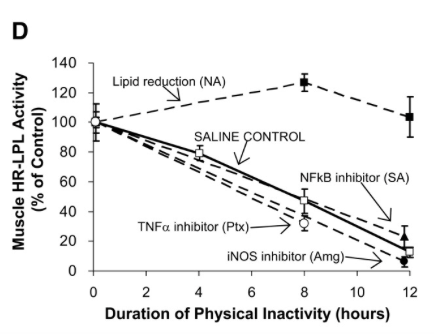
Seems pretty obvious that not doing anything can increase the risk of heart disease, but what these scientific studies are pointing out is just how damaging inactivity might be. In our modern world, inactivity may turn out to be just as important as poor diet or other more well-known factors for risk of heart disease or in fact risk of early death from any cause. So does your gym session help at all? Yes it does, but not as much as you might think.

“Watching TV for three hours or more per day was associated with increased mortality regardless of physical activity, except in the most active quartile, where mortality was significantly increased only in people who watched TV for five hours per day or more”
“…this high activity level attenuates, but does not eliminate the increased risk associated with high TV-viewing time. These results provide further evidence on the benefits of physical activity, particularly in societies where increasing numbers of people have to sit for long hours for work and may also inform future public health recommendations.” 2
So:
- Whilst exercise in any amount has big benefits, if you sit for more than three hours per day you have an increased risk of early death regardless of whether you exercise or not.
- If you’re really active, playing sport and training for example, that definitely helps.
- But it still doesn’t eliminate the increased risks.

The bad news, and the good news:
“Sitting time, TV time, and time sitting in automobiles, increase premature mortality risk.”
However, “…breaking up sedentary time is beneficial. ” 3
“Breaking sitting with standing and light-intensity walking effectively improved 24 h glucose levels and improved insulin sensitivity in individuals with type-2 diabetes to a greater extent than structured exercise. Thus, our results suggest that breaking sitting with standing and light-intensity walking may be an alternative to structured exercise to promote glycaemic control in patients with type 2 diabetes.” 4
Meaning that:
- The longer we are sitting down each day the higher our risk of early death.
- However, just getting up at regular intervals and walking around for a few minutes can actually make a scientific difference to our health.
- It may make sense for some people to do lots of regular bouts of mild exercise (like walking) throughout the day rather than schedule a set-time exercise session.
- This approach may be particularly relevant to people with type 2 diabetes to improve blood glucose control.
So what can you do??
- Be active. Go for that walk. Park further away. Take the stairs. Clean the house. Clear out the spare room. Wash your car by hand. Take on a project like woodwork or cleaning up an old but of furniture. Weed the garden. Plant out some veggies. Try a different exercise class that isn’t going a hundred miles an hour like yoga, tai chi, ballroom dancing, movement, anything! Look for ways throughout your day to be moving.
- Set a timer. If you’re sitting down a lot set a timer to go off every 45-55 minutes and then get up and walk around.
- Better yet, stand up while you’re working. Get a desk that allows you to do that or fashion your own.
A word of caution: CHALLENGES TO THE ABOVE RESEARCH (and any research for that matter)
One study looked at 14 young healthy people and measured their blood glucose after ingesting a standardised drink. One group was assigned to sit for 2.5 hours, the other group also had to sit for 2.5 hours but got up to walk for 2 minutes every 20 minute period. The study was encouraged by research suggesting that post-prandial hyperglycaemia is a predictive factor in the development of diabetes-related complications and cardiovascular events – i.e. if your blood sugar goes up too much after eating you could be more at risk of diabetes related problems, heart attack or stroke. The researchers measured blood glucose levels every 10 minutes. Their study showed that blood glucose responses were not changed by this break in sitting, or that there was no significant difference in the two groups. Here are some possible problems with this research (and unfortunately I don’t have access to the full text so its hard to be certain in my comments):
- The drink the subjects had was very high in sugar and/or the amount of sugar ingested was more important than whether the person was sitting or mostly sitting. So instead of looking at the sitting not having any effect, look at it as the sugar having the same effect on both groups. And if this is the case, I would suggest that… if you’re going to take two minute breaks in your sitting, that doesn’t mean you can eat a lot of sugar!
- Otherwise healthy, young people (as were used in the study) have generally better glycemic control, therefore they can handle a bit of sugar and a bit of sitting.
- The study was only done on a very small number of people so may not be a true reflection of the population
- The general population is unfortunately not healthy! So studies on healthy people often don’t reflect what is seen in the majority of people particularly middle-aged or older.
- The trial was short and looked at immediate single factor effects of breaking up sitting – it does not look at long term effects of sedentary lifestyle and therefore can’t be glanced at and taken to mean sitting all day is fine.
I wanted to include some opposing research to highlight the fact that scientific research requires scientific analysis. Often a research study is read by someone who interprets and then prints an article or headline. Meaning that you could read about this study in a newspaper or magazine with a headline like “Taking breaks from sitting will not affect your risk of diabetes or heart disease”. And so you may then have a completely different option on the matter than if you had read this article, or found numerous other studies linking inactivity with diabetes and heart disease. What you don’t get with that headline (or even some articles or blog posts) is the details of the study that are important. How many people were in the study? How long did it go for? Were the people healthy or already sick? Did they account for other factors like alcohol consumption, exercise habits, smoking and diet? And of course these things can all have a huge effect on how the results are interpreted.
- Curr Opin Cardiol. 2011 Sep;26(5):412-9. doi: 10.1097/HCO.0b013e3283496605. “Prolonged sitting: is it a distinct coronary heart disease risk factor?” Dunstan DW1, Thorp AA, Healy GN.
- Lancet. 2016 Sep 24;388(10051):1302-10. doi: 10.1016/S0140-6736(16)30370-1. Epub 2016 Jul 28. “Does physical activity attenuate, or even eliminate, the detrimental association of sitting time with mortality? A harmonised meta-analysis of data from more than 1 million men and women.” Ekelund U1, Steene-Johannessen J2, Brown WJ3, Fagerland MW4, Owen N5, Powell KE6, Bauman A7, Lee IM8; Lancet Physical Activity Series 2 Executive Committe; Lancet Sedentary Behaviour Working Group.
- Exerc Sport Sci Rev. 2010 Jul; 38(3): 105–113. “Too Much Sitting: The Population-Health Science of Sedentary Behaviour” Neville Owen,1 Geneviève N Healy,1,2 Charles E. Matthews,3 and David W. Dunstan2
- Diabetologia. 2016 Dec 1. [Epub ahead of print] “Breaking sitting with light activities vs structured exercise: a randomised crossover study demonstrating benefits for glycaemic control and insulin sensitivity in type 2 diabetes.”Duvivier BM1,2,3, Schaper NC4,5, Hesselink MK6, van Kan L6, Stienen N4, Winkens B5,7, Koster A5,8, Savelberg HH6.
-
Int J Sports Med. 2016 Dec;37(14):1097-1102. doi: 10.1055/s-0042-113466. Epub 2016 Oct 7. “Breaking up Prolonged Sitting does not Alter Postprandial Glycemia in Young, Normal-Weight Men and Women.” Hansen RK1, Andersen JB1, Vinther AS1, Pielmeier U1, Larsen RG1.
- Marc T. Hamilton1,2, Deborah G. Hamilton1 and Theodore W. Zderic1 “Role of Low Energy Expenditure and Sitting in Obesity, Metabolic Syndrome, Type 2 Diabetes, and Cardiovascular Disease”